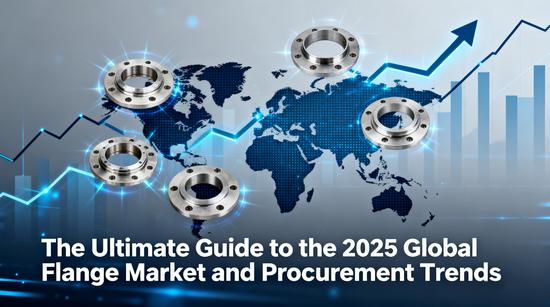

The global industrial piping sector is currently navigating a period of profound transformation, characterized by the convergence of heightened geopolitical friction, rapid material science innovation, and an accelerating transition toward sustainable energy infrastructure. As the industry advances through 2025 and forecasts into 2026, the market for flanges and pipe fittings—critical components ensuring the integrity of fluid transport systems—is being reshaped by a distinct set of macroeconomic and technical drivers.
This report provides an exhaustive analysis of the global flange market, responding to the urgent need for clarity on technical standards, trade compliance, and regional growth vectors. It addresses the rising prominence of specialized components, such as Stainless Steel Stub End Fittings and ASME B16.9 Lap Joint connections, which offer strategic cost advantages in an era of volatile alloy prices. Furthermore, it dissects the implications of rigorous U.S. trade policies, specifically the enforcement of Section 232 tariffs and the 40% transshipment penalty, which have necessitated new compliance pathways for exporters.
From the booming infrastructure projects of the Middle East to the high-tech manufacturing pivots in China, and the adoption of "Green Steel" for hydrogen applications, this document serves as a comprehensive guide for stakeholders. It integrates technical product specifications—ranging from ASTM A105N Carbon Steel forgings to Duplex 2205 specialty flanges—with high-level market intelligence, offering a roadmap for navigating the complex terrain of the 2025-2026 global flange industry.
Chapter 1: The Anatomy of Connection – Technical Fundamentals of Flanges and Stub Ends
1.1 Defining the Flange in Modern Industry
At its most fundamental level, a flange is a forged or cast ring designed to connect sections of pipe, or to join pipe to a pressure vessel, valve, pump, or other integral assembly. While the basic concept is centuries old, the modern industrial flange is a highly engineered component subject to rigorous metallurgical and dimensional standards. It serves not merely as a connector, but as a critical safety barrier in high-pressure, high-temperature, and corrosive environments.
The selection of a flange type is never arbitrary; it is dictated by the fluid mechanics of the system, the aggressiveness of the media, and the economic constraints of the project. In 2025, the industry has seen a resurgence in the popularity of "loose" or "lap joint" systems, specifically the Stainless Steel Stub End Fitting – ASME B16.9 Lap Joint, driven by the necessity to optimize material costs without compromising wetted surface integrity.
1.2 The Mechanics of the Lap Joint and Stub End System
One of the most technically sophisticated yet economically efficient designs in the current market is the Lap Joint system. This configuration separates the flange's two primary functions: retaining hydraulic pressure and resisting chemical attack.
1.2.1 The Stainless Steel ASME B16.9 Stub End
The "Stub End" is essentially a short length of pipe, manufactured to ASME B16.9 standards for butt-welding fittings. One end of this fitting is flared outward to form a narrow shoulder or "lap." This component is the only part of the connection that comes into contact with the process fluid.
-
Fabrication Methods: These fittings are available as Seamless, Welded, or Stamping Pipe Fittings. Seamless stub ends, produced from seamless pipe stock, are preferred for high-pressure and high-temperature applications where uniform grain structure is paramount. Welded or stamped versions are utilized in lower-criticality utility lines.
-
Materiality: Because the stub end is the wetted part, it is typically manufactured from corrosion-resistant alloys such as 304/316 Stainless Steel or exotic grades like Duplex 2205.
1.2.2 The Backing Flange: Loose and Rotating
The Stainless Steel Lap Joint Stub End | ASME B16.9, MSS SP-43 & ANSI B16.28 Standards system utilizes a backing flange—often referred to as a "Loose Flange"—that slips over the pipe and presses against the back of the stub end's lap. This flange is not welded to the pipe; it floats freely.
-
The Cost Advantage: Since the backing flange never touches the corrosive fluid, it does not need to be made of expensive stainless steel. It is standard practice to pair a high-grade stainless stub end with an ASTM A105 Carbon Steel backing flange. In large diameter systems (e.g., DN350 and above), this can reduce the total alloy weight of the connection by 60-70%, offering a massive reduction in Project CAPEX.1
-
Alignment Utility: The ability of the backing flange to rotate freely around the stub end simplifies bolt hole alignment during field installation. This is particularly valuable in complex offshore piping spools or tight refinery retrofits where fixed Weld Neck flanges might require difficult rework if bolt holes do not align perfectly.2
1.3 The Industrial Backbone: Carbon Steel Forgings
While alloy stub ends solve corrosion challenges, the vast majority of global energy infrastructure relies on robust carbon steel components.
1.3.1 ASTM A105N Carbon Steel – BW Forged Pipe Flange
The "workhorse" of the oil and gas sector is the ASTM A105N Carbon Steel flange. The "N" designation indicates that the steel has been Normalized. Normalization is a heat treatment process where the forging is heated to approximately 900°C (depending on carbon content) and then air-cooled.
-
Metallurgical Impact: This process refines the grain structure of the steel, making it more uniform and significantly improving its notch toughness. This is critical for flanges used in colder climates (e.g., North American winters or North Sea platforms) where standard carbon steel might become brittle and susceptible to fracture.
-
Connection Type: The BW (Butt Weld) configuration is standard for high-pressure transmission. The tapered hub of the weld neck flange transfers stress from the flange to the pipe wall, reducing stress concentration at the junction.
1.3.2 Carbon Steel Flat Welding Loose DN350 LTF Flange
Moving from high-pressure oil to municipal water infrastructure, the Carbon Steel Flat Welding Loose DN350 LTF Flange represents a different engineering priority.
-
Design: "Flat Welding" typically refers to a Slip-On or Plate flange design where the pipe is inserted into the flange and fillet welded. The "Loose" designation often implies a composite design similar to a lap joint or a specific ring-type assembly used in waterworks.
-
Scale: The DN350 size (equivalent to 14 Inch NPS) is a critical threshold in infrastructure. It represents the transition from distribution piping to transmission mains in municipal water networks. The demand for DN350 Carbon Steel Loose – Flat Welding LTF Flange components is currently being driven by massive water security projects in the Middle East, where ease of installation in trench environments is prioritized over the extreme pressure ratings of oil pipelines.
1.4 Emerging Technologies: The Press Flange
The 2025 304/316 Stainless Steel Press Flange represents a shift toward labor-saving technology. In commercial building services and light industrial applications, "Press-fit" or "Press" technology eliminates the need for welding. These flanges feature an integrated EPDM or FKM sealing element and are secured to the pipe using a hydraulic pressing tool.
-
Strategic Value: In 2025, with skilled welders in short supply globally, the ability to install a flange in seconds without a hot work permit is a significant market driver.
Chapter 2: The Regulatory Fortress – U.S. Trade Policy and the 2025 Geopolitical Landscape
The global trade of flanges is no longer a free market; it is a regulated domain defined by national security interests and protectionist policies. The impact of U.S. foreign policy changes on the global flange market has been seismic, creating a complex web of tariffs that dictates sourcing strategies.
2.1 The Section 232 Regime: The 50% Reality
Since 2018, Section 232 of the Trade Expansion Act of 1962 has been the primary instrument of U.S. protectionism in the steel sector. In 2025, this policy was aggressively reinforced.
-
The Escalation: The tariff rate on steel imports from most non-exempt countries was raised from 25% to 50%.4 This tariff applies to the entered value of the goods.
-
Scope: The scope of Section 232 is comprehensive. It covers not just raw steel mill products but "derivative products," which explicitly includes pipe fittings and flanges classified under HTS Chapter 73 (Articles of Iron or Steel).6
-
Implication: For an importer bringing in 12 Inch ANSI B16.5 Class 300 Carbon Steel flanges from a country subject to the tariff (e.g., China, Brazil, or non-exempt Asian nations), the landed cost effectively increases by half. This has decimated the margins for standard commodity flanges and forced a shift toward high-value, specialized components where the tariff can be absorbed, or toward sources with specific exclusions.
2.2 The 40% Transshipment Penalty: Closing the Loophole
Perhaps the most significant development in 2025 is the U.S. administration's crackdown on transshipment. For years, manufacturers circumvented tariffs by shipping Chinese semi-finished goods to third countries (Vietnam, Malaysia, Thailand) for minimal processing before re-exporting them to the U.S. as "Vietnamese" origin.
-
The New Rule: Executive Orders in 2025 authorized U.S. Customs and Border Protection (CBP) to impose a 40% penalty tariff—in addition to standard duties—on goods determined to be transshipped to evade tariffs.8
-
Strict Liability: The penalty is applied with strict liability, meaning lack of intent is not a defense. If the supply chain audit reveals that the ANSI B16.5 Stainless Steel Forged – Loose Flange originated in China and was merely repacked in a third country, the penalty applies.
-
The "China+1" Trap: This policy explicitly targets the "China+1" manufacturing strategy. Companies that set up shell factories in Southeast Asia without establishing genuine manufacturing capabilities are now in the crosshairs of this enforcement regime.9
2.3 Compliance Breakthroughs: Substantial Transformation
To legally navigate this landscape, specifically for high-value items like 2025 Changes in Flange Exports to the US: Three Compliance Breakthrough Paths for Duplex Steel Flanges, exporters must understand the legal doctrine of Substantial Transformation.
-
The Legal Test: A product is considered to originate in the country where it undergoes a "substantial transformation" resulting in a new and different article of commerce with a new name, character, and use.
-
Application to Flanges: U.S. courts and CBP rulings (e.g., Midwood Industries v. United States) have established precedents specific to flanges.
-
Insufficient: Importing a "blank" or rough flange and merely threading it, painting it, or beveling the face does not constitute substantial transformation. The origin remains the country where the steel was forged.10
-
Sufficient: Importing a raw steel billet or rough forging (biscuit) and performing the complete machining process—turning the OD, boring the ID, facing the seal surface, drilling bolt holes to ASME B16.5 tolerances, and heat treating—does typically confer origin to the country of machining.11
-
-
Strategic Path: Therefore, the compliant path for China Supply ANSI B16.5 Std. 150#/300# Carbon Steel Lap Joint Stub Ends involves ensuring that the transformation from raw steel to finished component happens entirely within a jurisdiction that is not subject to Section 301 or punitive Section 232 rates, or paying the tariff legitimately.
2.4 Tariff Engineering and the "Melt and Pour" Standard
A sophisticated strategy emerging in 2025 is "Tariff Engineering" based on the Melt and Pour requirement.
-
The Rule: For certain exclusions, the U.S. requires that the steel not only be forged in an exempt country but also "melted and poured" there (or in the U.S.).
-
The Opportunity: Some exporters are sourcing steel billets that were melted in the U.S. or Mexico, shipping them to Asia for high-precision forging into OEM ODM ASME B16.9 DN200 Stainless Steel – Loose Flange components, and then re-importing them. Because the raw material origin is compliant, these goods may qualify for preferential treatment or reduced scrutiny, provided the supply chain traceability is impeccable.13
Chapter 3: Regional Powerhouses – The Middle East Construction Boom and Vision 2030
While the West focuses on trade barriers, the Middle East is characterized by an unprecedented infrastructure boom. The Middle East Flange Market Trends 2024 indicate a robust growth trajectory driven by sovereign vision strategies, specifically Saudi Arabia's Vision 2030.
3.1 Water Security: The Desalination Drive
The Gulf Cooperation Council (GCC) nations are investing billions in water security. Qatar's "Mega Reservoirs Project" and Saudi Arabia's sprawling desalination plants along the Red Sea are creating massive demand for piping components.
-
Material Shift: In the past, coated carbon steel was common. However, the high salinity and temperature of Gulf seawater create a perfect storm for corrosion. Consequently, there is a massive shift toward Duplex 2205 (UNS S32205) and Super Duplex stainless steels for wetted parts.14
-
Duplex Advantage: Duplex 2205 offers superior resistance to Chloride Stress Corrosion Cracking (CSCC) compared to 316L, and its higher strength allows for thinner wall thicknesses, reducing the overall weight of the piping system.
-
Product Demand: The demand profile in this sector is heavily skewed toward ASTM A182 Carbon Steel | ASME B16.5 EN1092-1 Plate RF/FF Forged Stub End Flange configurations. The use of a Duplex Stub End with a Carbon Steel backing flange is the standard value-engineering solution for these mega-projects.
3.2 Municipal Infrastructure: The Rise of DN350+
Beyond industrial desalination, the expansion of cities like Riyadh and NEOM requires extensive municipal water distribution networks.
-
Scale: These networks rely on large-diameter transmission mains, typically DN350 (14") to DN1000 (40").
-
Component Specification: The DN350 Carbon Steel Loose – Flat Welding LTF Flange is a critical component here. The "Loose" or rotating flange design is preferred in civil construction because it simplifies the installation of heavy pipes in trench conditions where perfect alignment is difficult.
-
Ductile Iron vs. Steel: While Ductile Iron pipes are dominant in this sector 15, Carbon Steel flanges are often used at pumping stations and valve interfaces due to their higher pressure ratings and durability against water hammer surges.
3.3 Oil & Gas: The "Cleaner" Molecule
The Middle East is not abandoning hydrocarbons but is pivoting toward "cleaner" energy exports like Blue Hydrogen and Ammonia.
-
Technical Challenge: Transporting ammonia or high-pressure gas requires flanges with impeccable sealing integrity. API Standard PN60 Carbon Steel Loose flanges are often specified for wellhead and gathering lines.
-
Clarification on "PN60": It is important to distinguish between API (American Petroleum Institute) pressure classes (2000, 3000, 5000, 10000 psi) and ISO/EN "PN" (Nominal Pressure) ratings (PN10, PN16, PN40, PN64, PN100). "PN60" is a non-standard designation in common API 6A nomenclature; typically, high-pressure API flanges align with Class 400/600 or PN64/100 ratings. However, in specific regional tenders, hybrid designations appear. A PN60 rating generally implies a working pressure of 60 bar (~870 psi), placing it roughly between ASME Class 300 and Class 600.16 This specific rating targets mid-stream gathering lines where Class 600 is over-engineered (too heavy/expensive) and Class 300 is insufficient.
Chapter 4: The Chinese Pivot – High-End Manufacturing and Global Supply Chains
China’s Flange Market Snapshot (Latest Two Months) reveals a sector in transition. Faced with U.S. tariffs and European carbon taxes (CBAM), Chinese manufacturers are moving up the value chain.
4.1 The "New Three" Export Strategy
China's export economy is increasingly driven by the "New Three": Electric Vehicles (EVs), Lithium Batteries, and Photovoltaic (Solar) products.18
-
Flange Implications: This shift is creating domestic demand for high-precision, small-diameter flanges used in battery cooling systems and semiconductor manufacturing equipment. The 2025 304/316 Stainless Steel Press Flange is a key product here, supporting the rapid construction of clean-rooms and gigafactories where welding is prohibitive.
4.2 Resilience Through Diversification
Despite Western "de-risking," China remains the central node in the global steel supply chain.
-
Market Diversification: Chinese exports of China Supply ANSI B16.5 Std. 150#/300# Carbon Steel Lap Joint Stub Ends are increasingly flowing to ASEAN, Latin America, and the Middle East.19
-
Smart Manufacturing: To compete with low-cost producers like India or Vietnam, Chinese mills are investing in "Smart" factories. This involves automated forging lines and real-time quality control systems that can produce OEM ODM ASME B16.9 DN200 Stainless Steel flanges with micron-level tolerances, reducing the rejection rate and justifying a higher price point.20
Chapter 5: Material Science in the Energy Transition – From Carbon Steel to Green Hydrogen
The Flange Sector Navigates Energy Transition with Material Innovation title encapsulates the technical shift occurring in 2025. The move toward Net Zero is not just a policy goal; it is a metallurgical challenge.
5.1 Hydrogen Embrittlement and Material Selection
The global build-out of hydrogen infrastructure necessitates a re-evaluation of standard carbon steels. Hydrogen atoms can diffuse into the steel lattice, causing Hydrogen Embrittlement—a catastrophic reduction in ductility that can lead to sudden cracking.
-
The Material Response: Standard ASTM A105N Carbon Steel is often unsuitable for high-pressure pure hydrogen service. The industry is shifting toward Austenitic Stainless Steels (316L, 316Ti) with high nickel content, which are naturally resistant to hydrogen diffusion.
-
Specialized Flanges: The 2025 Stainless Steel – Loose Flange for Oil and Gas market is seeing a sub-segment develop for "Hydrogen-Ready" flanges. These require specific heat treatments and impact testing at extremely low temperatures (-196°C) to ensure ductility.
5.2 Green Steel: The Decarbonized Flange
European markets, driven by the Carbon Border Adjustment Mechanism (CBAM), are demanding Green Steel.
-
Definition: Steel produced using Green Hydrogen (H2) to reduce iron ore, rather than coal-fired blast furnaces. This reduces the carbon footprint of the steel by up to 95%.21
-
Market Impact: Major projects are beginning to specify "Green Steel" for their piping components. A 12 Inch ANSI B16.5 Class 300 Carbon Steel flange made from H2-reduced steel carries a premium but allows the project owner to claim carbon credits. Companies like H2 Green Steel (H2GS) are leading this supply chain revolution.
5.3 High-End Alloys for Extreme Environments
As oil and gas exploration moves to deeper, hotter, and more corrosive reservoirs, the demand for "High-End" alloys grows.
-
Super Duplex: Beyond standard 2205, Super Duplex (UNS S32750) flanges are required for subsea applications where pressures exceed 10,000 psi and temperatures fluctuate wildly.
-
ASME A403 Stainless Steel Forged Water Pipe Lap Joint Flanges: In high-purity water systems (e.g., semiconductor fabrication or pharma), standard stainless is insufficient. ASME A403 fittings in grades like 316L VIM/VAR (Vacuum Induction Melting / Vacuum Arc Remelting) ensure zero impurities that could contaminate the process fluid.
Chapter 6: Digitalization and Logistics – The Smart Supply Chain
The physical movement and tracking of flanges have become as important as their manufacture. Flange Industry News: Technological Innovation and Sustainability Drive New Market Momentum highlights this trend.
6.1 Logistics: The Battle Against Rust
A critical, often overlooked aspect of the global flange trade is preservation. With shipping routes disrupted (e.g., Red Sea bypasses adding 2 weeks to transit times), Carbon Steel flanges are at high risk of corrosion before they even reach the customer.
-
The Problem: Salt air and humidity in ocean freight containers can flash-rust a machined flange face in days. A rusty sealing face on an ANSI ASME B16.5 Steel Forged Lap Joint Flange renders it useless.
-
The Solution: Anti-Rust Oil: Leading manufacturers are now applying advanced Anti-Rust Oils and VCI (Vapor Corrosion Inhibitor) coatings. Unlike traditional heavy grease, these modern oils form a dry-to-touch molecular barrier that provides months of protection but does not require solvent cleaning before welding.22
-
Economic Value: Specifying "Anti-Rust Oil" is a cost-benefit no-brainer. The cost of the oil is negligible compared to the cost of sandblasting and re-machining thousands of flanges at a job site.24
6.2 Digital Product Passports (DPP) and Blockchain
The era of anonymous steel is ending.
-
Digital Product Passports: The EU's new regulations require a Digital Product Passport for construction products. This is a digital record, accessible via QR code on the flange, that contains its full history: mill certificate, chemical analysis, heat treatment graphs, and carbon footprint data.25
-
Blockchain Traceability: To prove compliance with U.S. "Melt and Pour" rules and avoid transshipment penalties, manufacturers are using blockchain. A Blockchain-backed MTR (Material Test Report) creates an immutable link between the physical ASTM A182 Carbon Steel flange and its origin documentation, rendering fraud nearly impossible.27 This level of transparency is becoming a requirement for Tier 1 contractors in the Energy sector.
Chapter 7: Strategic Sourcing and Compliance – Navigating the Future
The 2026 Flange Export Trends: High-End, Low-Carbon, Smart suggest a bifurcated market. On one side, commodity flanges will continue to face tariff wars and commoditization. On the other, specialized, traceable, and sustainable components will command premiums.
7.1 Compliance Pathways for the U.S. Market
For exporters targeting the U.S., the path forward involves rigorous adherence to the "Three Compliance Breakthrough Paths":
-
Strict Substantial Transformation: Ensure machining processes in the intermediate country are robust enough to meet the legal threshold of transformation, fully documented with production logs.
-
Origin Segmentation: Clearly segregate inventory. Use ANSI Standard A105 Stainless Steel – Pipe Flange components sourced from tariff-friendly nations (e.g., Mexico, Korea) specifically for U.S. orders, while using Chinese stock for other markets.
-
Digital Verification: Proactively offer digital traceability to U.S. Customs brokers to expedite clearance and prove the legitimacy of the supply chain.
7.2 The Stub End Strategy
For buyers, the Stainless Steel Stub End + Carbon Steel Loose Flange remains the ultimate hedge against market volatility. By decoupling the commodity price of Iron (the flange) from the volatile price of Nickel (the stub end), projects can lock in costs more effectively.
7.3 Conclusion
The flange industry of 2025 is a testament to the complexity of the modern world. A simple ANSI B16.5 Stainless Steel Forged – Loose Flange is now a product of advanced metallurgy, global legal maneuvering, and digital certification. For stakeholders—whether they are manufacturers in China, distributors in Texas, or project managers in Saudi Arabia—success depends on mastering not just the hardware, but the information and regulations that surround it. The future belongs to those who can deliver the "High-End, Low-Carbon, Smart" connection.
Statistical Appendix: Market Data and Technical Comparisons
Table 1: Pressure Rating Equivalencies and Applications
| ASME B16.5 Class | ISO/EN PN Rating (Approx.) | Working Pressure (Ambient) | Typical Application |
| Class 150 | PN 20 | ~285 psi (19.6 bar) | General water service, low-pressure gas, utility lines. |
| Class 300 | PN 50 | ~740 psi (51 bar) | 12 Inch ANSI B16.5 Class 300 Carbon Steel lines for oil/gas transmission. |
| Class 600 | PN 100 / PN 110 | ~1480 psi (102 bar) | High-pressure refinery process lines, hydraulic systems. |
| Class 900 | PN 150 | ~2220 psi (153 bar) | Injection pipelines, power plant steam. |
| Class 1500 | PN 250 | ~3705 psi (255 bar) | Critical high-pressure systems. |
| Class 2500 | PN 420 | ~6170 psi (425 bar) | Deep-sea subsea applications. |
| API 2000 | N/A | 2000 psi | Wellhead equipment (often overlaps with Class 600/900 dimensions). |
| Hybrid | API Standard PN60 | ~870 psi (60 bar) | Specialized mid-stream gathering lines in specific regional tenders. |
Table 2: Comparative Analysis of Flange Types
| Flange Type | Description | Key Advantage | Key Disadvantage | Ideal Application |
| Weld Neck (WN) | Tapered hub butt-welded to pipe. | Maximum strength, best stress distribution, suitable for X-ray inspection. | Requires precise alignment, expensive installation (welding). | High-pressure, high-temp, critical pipelines (ASTM A105N Carbon Steel). |
| Slip-On (SO) | Slips over pipe, fillet welded. | Lower material cost, easy alignment. | Lower strength than WN, fillet welds are harder to inspect. | Low-to-medium pressure utility lines. |
| Lap Joint (LJF) + Stub End | Loose flange + flared pipe end. | Cost Efficiency: Flange can be Carbon Steel while Stub End is Stainless. Rotatable: Easy bolt alignment. | Low pressure rating (typically limited to Cl. 300 equivalent). | Corrosive systems (Desalination, Chemical) using Stainless Steel Stub End Fitting. |
| Blind | Solid plate. | Seals the end of a line. | Heavy, high stress concentration at center. | Pressure vessel openings, future expansion points. |
| Socket Weld (SW) | Pipe inserts into socket, fillet weld. | Good for small bore (<2"), no internal weld flash. | Crevice can cause corrosion; not for radioactive/corrosive service. | Small instrumentation lines. |
| Threaded | Screwed connection. | No welding required (spark-free). | Leak prone at high cyclic stress/temp. | Low-pressure water, air service (2025 304/316 Stainless Steel Press Flange is replacing this). |
Table 3: Material Grades and Compliance
| Material Grade | Standard | Characteristics | Compliance Notes (2025) |
| Carbon Steel | ASTM A105N | Normalized for toughness. Standard industrial grade. | Subject to Section 232 (50%) tariff if non-exempt. High risk of rust during shipping (requires Anti-Rust Oil). |
| Stainless 304/304L | ASTM A182 F304 | "18-8" Stainless. Good general corrosion resistance. | Commodity grade. Price fluctuates with Nickel market. |
| Stainless 316/316L | ASTM A182 F316 | Molybdenum added. Better pitting resistance. | Standard for marine/chemical. Essential for Stub End wetted parts. |
| Duplex 2205 | ASTM A182 F51 | Mixed microstructure. High strength, superior CSCC resistance. | Critical for Middle East desalination. Subject to 40% Transshipment Penalty scrutiny. |
| Super Duplex | ASTM A182 F53/F55 | Extreme corrosion resistance. | Used in subsea/offshore. High value = high tariff risk. |
| Ductile Iron | EN 545 | Cast iron with nodular graphite. Flexible, strong. | Dominant in municipal water (DN350 Carbon Steel Loose is the steel alternative). |
Table 4: U.S. Tariff Impact Scenarios (2025)
| Product Origin | Processing | Tariff Application | Strategy |
| China | Manufactured & Finished in China | Section 301 (25%) + Section 232 (50%) | Unviable for commodities. Focus on high-precision/custom OEM parts. |
| China -> Vietnam | Repacked/Painted in Vietnam | Sec 301 + Sec 232 + 40% Penalty | Illegal. Avoid at all costs. |
| China -> Vietnam | Substantial Transformation (Forging/Machining) | Standard MFN Duty (if applicable) | Must prove transformation via detailed production logs. |
| India/Korea | Melted & Manufactured in Country | Standard Duties (Sec 232 may apply) | "Safe" sourcing but higher base cost. |
| Mexico/Canada | Melted & Poured in USMCA zone | Duty Free (typically) | The "Gold Standard" for U.S. importers (Tariff Engineering). |